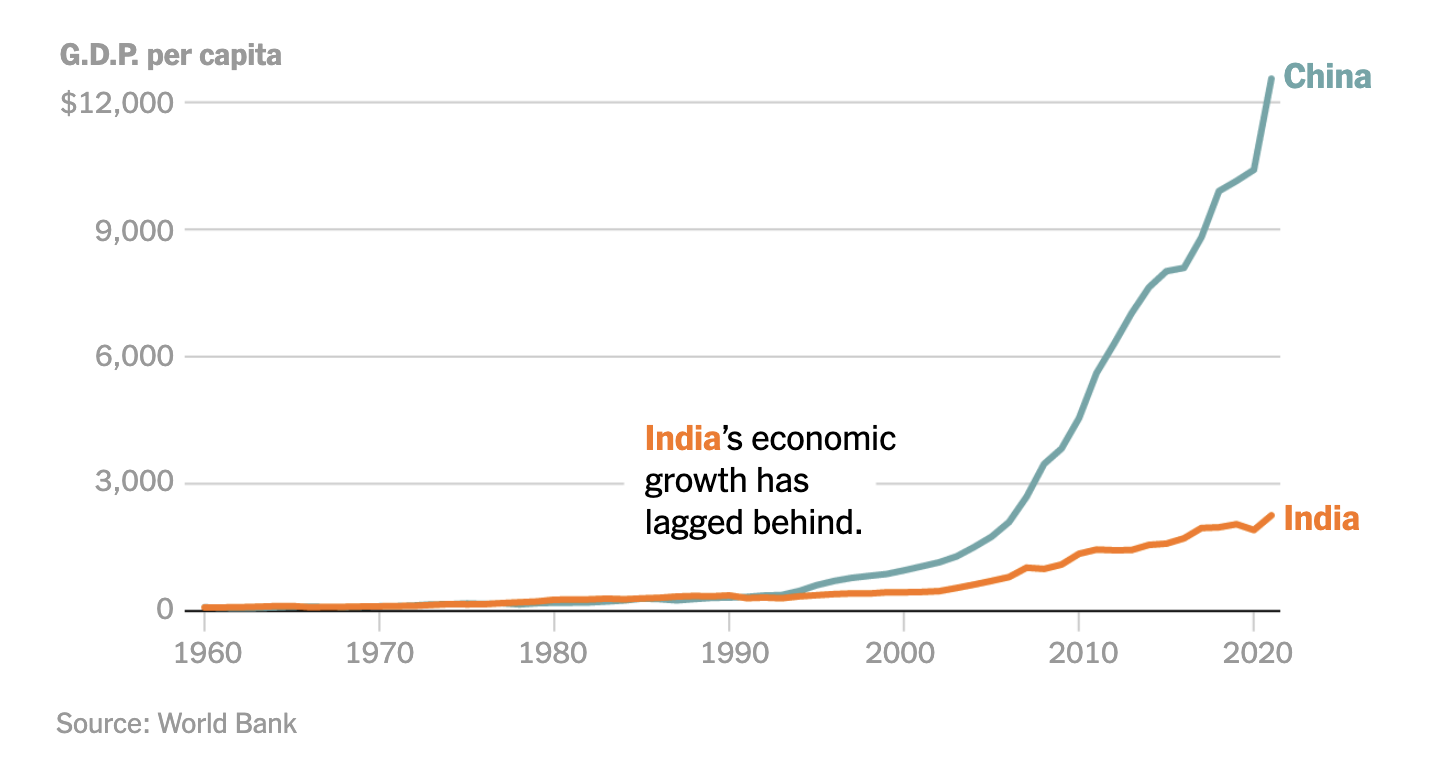
NYT had a nice piece recently on (the entirely statistical phenomenon of) India overtaking China in population. All their graphs are worth pondering over, but I’ve always been fascinated by this one:
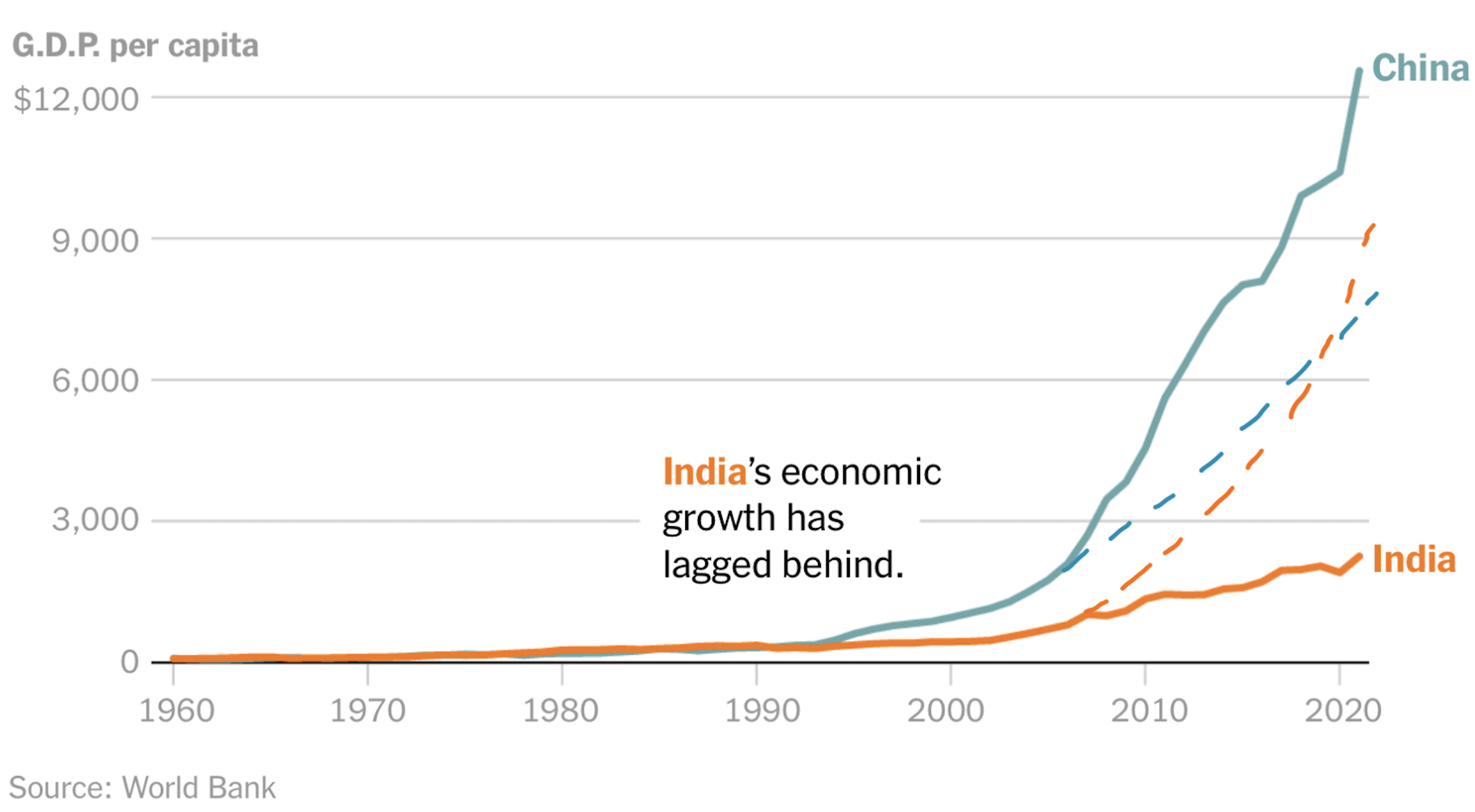
Growing up in the 2000s, I remember seeing an entirely different prediction. Those were the heady days of “India Superpower 2020”, when India and China were lumped together as equals, poised to take over the “Asian century”. If memory serves, the dashed lines would represent what we were led to believe then:
An even starker observation, harder to show in a nice graph, is that India’s GDP per capita in 2020 was approximately the same as US GDP per capita around the 1850s (in nominal terms; if one believes more in PPP, the equivalence will be to US GDP per capita around 1925).
Now that it is well past 2020 and India is nowhere close to being a real superpower like the US or an upcoming superpower like China, this should be the perfect time to reach a reckoning about a more realistic idea of India. The NYT piece provides a glimpse at this at the very end – a services led economy. Obviously this has its own failings, but once there is broad consensus on the most sensible idea, there can be better strategic coordination, on public policy, industrial policy, education, and so on. Unfortunately that doesn’t seem to be the case at all. Instead, the smallest bit of “advantage” is latched on to as the big thing to celebrate – desperate attempts to keep the “India Superpower” story alive. As soon as the population story hit, this endless cycle repeated itself, this time focusing on India’s demographic dividend advantage. Even setting aside the dangerous regional disparities in population growth (especially given that the population expansion comes from poorer, backward states, summarized here), there seems to be no strategy on how to utilize this dividend. Deploying a hammer with no nail can only lead to destroying the wall, and eventually the house.
 aroonwithaview
Leave a comment